
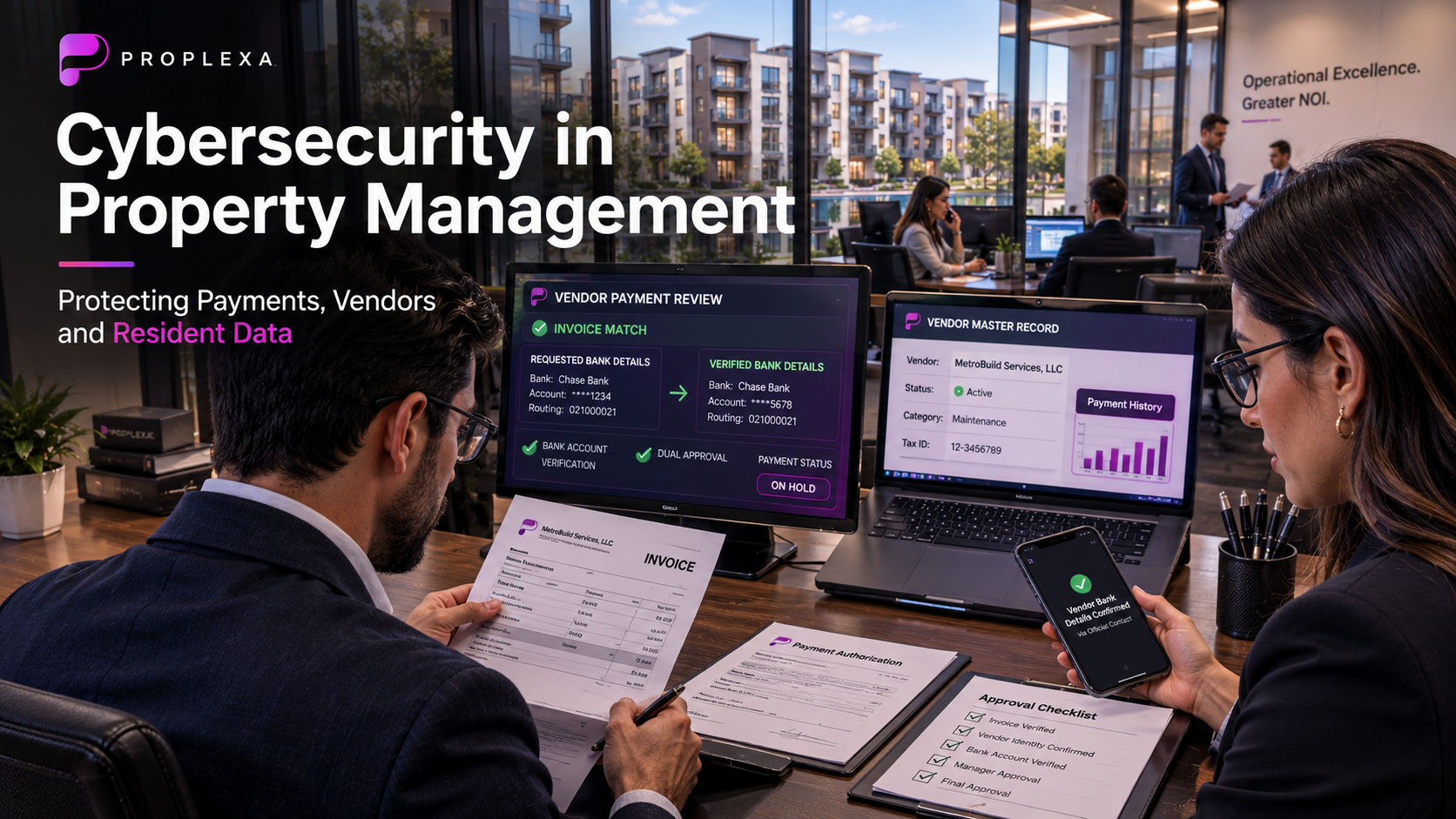
Property management has become a highly digital business.
A single management company may process thousands of rental payments, maintain resident records, coordinate vendors, manage bank accounts and operate multiple software platforms across different properties.
That creates efficiency. It also creates exposure.
A compromised email account, fraudulent vendor invoice or unauthorized change to banking instructions can turn an ordinary administrative process into a serious financial incident.
For multifamily owners, cybersecurity should therefore be considered part of property management oversight—not simply an IT responsibility.
1. Real Estate Is Already a Target for Digital Financial Fraud
The FBI's 2025 Internet Crime Report, released in April 2026, documented:
- $275.1 million in reported losses under its real estate fraud category.
- 12,368 real estate-related complaints.
- $3.05 billion in reported losses from Business Email Compromise (BEC).
- 24,768 BEC complaints.
These figures cover the broader U.S. real estate and cybercrime landscape, not multifamily property management alone. Nevertheless, they illustrate the financial exposure associated with digital transactions and impersonation.
fbi.gov+1
For property managers, the risk is especially relevant wherever an employee can change payment instructions, access financial accounts or authorize vendor disbursements.
2. Business Email Compromise: A Risk Hidden in Routine Operations
Business Email Compromise occurs when criminals impersonate or compromise legitimate business email accounts to manipulate financial transactions.
Consider a realistic property-management scenario:
- A vendor regularly sends invoices to the management company.
- A criminal gains access to an email account or impersonates the vendor.
- The criminal sends an invoice with modified banking instructions.
- An employee processes the payment using the new account details.
- The money is transferred to an account controlled by the criminal.
The invoice may contain the correct property name, vendor information, amount and payment history.
The weakness is not necessarily the accounting software. It may be the absence of an independent verification process.
The FBI specifically recommends verifying changes to account information through a secondary communication channel.
Internet Crime Complaint Center (IC3)+1
3. The Five Cybersecurity Risks Property Owners Should Understand
Payment diversion
Fraudulent changes to vendor banking details, rent payment instructions or other financial information.
Email account compromise
Unauthorized access to employee accounts that contain invoices, resident information or financial correspondence.
Resident data exposure
Unauthorized access to personal information, identification documents, lease records and payment-related information.
Third-party software vulnerabilities
Property managers depend on payment processors, accounting systems, leasing platforms, maintenance applications and external service providers. Weaknesses in one part of the technology chain can affect others.
Unauthorized employee access
Former employees, contractors or staff members may retain access to systems they no longer need.
The common issue is excessive trust in digital identities and processes without sufficient verification.
4. What Stronger Security Controls Look Like
A professional property management company should have documented controls covering at least six areas.
Control
What owners should expect
Multi-factor authentication
MFA for email, accounting and financial systems
Payment verification
Independent confirmation of banking changes
Role-based access
Employees access only the information necessary for their jobs
Vendor controls
Verified vendor identities and payment details
Audit trails
Records of payment approvals, account changes and administrative activity
Incident response
Documented procedures for reporting, containing and investigating incidents
Multi-factor authentication deserves particular attention.
NIST recommends enabling MFA on sensitive business accounts and prioritizing phishing-resistant authentication methods where available. These include passkeys and FIDO-based security keys.
NIST+1
5. AI Is Changing the Cybersecurity Environment
The threat is not limited to traditional phishing emails.
IBM's 2026 Cost of a Data Breach research found that one in four malicious breaches in its study were AI-enabled, representing a 56% increase over the previous year. These incidents cost an average of approximately $6 million globally.
IBM Newsroom+1
This research covers organizations across industries, not property management companies specifically.
However, its implications are relevant to property operations: impersonation, manipulated communications and automated attacks can make it harder to determine whether a request actually comes from a legitimate employee, vendor or business partner.
The appropriate response is not to eliminate digital workflows. It is to establish stronger identity verification and approval procedures around sensitive transactions.
6. A Practical Payment-Control Protocol
One of the most valuable controls is a formal process for changing vendor or banking information.
A sound protocol should require:
- A written request documenting the proposed change.
- Verification using a previously established telephone number—not the number included in the change request.
- Confirmation by an authorized employee independent of the person entering the change.
- Documentation of the verification.
- A recorded approval before the first payment to the new account.
The National Association of REALTORS® similarly recommends independently verifying wire instructions and treating last-minute changes with particular caution.
nar.realtor+1
The principle is simple: an email should never be the only authorization for changing where money goes.
7. Questions Owners Should Ask Their Property Manager
Cybersecurity should become part of the management-company evaluation process.
Owners should ask:
- Is MFA required for all financial and administrative systems?
- Who can change vendor banking information?
- Are payment changes independently verified?
- How are employee permissions assigned and removed?
- Are financial approvals separated between employees?
- How frequently are access permissions reviewed?
- Are third-party software providers evaluated?
- Are security incidents documented and reported to owners?
- Is there a written incident-response and business-continuity plan?
- How are resident records protected and retained?
Owners should also understand which responsibilities belong to the PMC, which belong to software providers and which remain with the property owner.
8. Where Proplexa Fits
Selecting a property management company is not just a comparison of fees, leasing services or maintenance capabilities.
It is also a decision about who will have access to sensitive information and financial workflows associated with an owner's assets.
Through a structured RFP, Proplexa can help owners ask management companies to explain their:
- Financial approval procedures
- Payment security controls
- Technology platforms
- Data protection practices
- Vendor verification processes
- Access management policies
- Incident-response procedures
- Reporting and accountability standards
The objective is to make operational quality more transparent before an owner enters into a management relationship.
The Bottom Line
Property management companies are responsible for more than physical buildings.
They also manage digital identities, financial transactions, sensitive records and interconnected technology systems.
In 2026, owners should evaluate cybersecurity as part of the broader management relationship.
A property manager should be able to explain not only how it collects rent and pays vendors, but also how it verifies that the money is going to the right place.
Because protecting a property also means protecting the systems used to operate it.