
When purchasing a multifamily property, investors spend weeks—sometimes months—performing due diligence.
They analyze:
- Financial statements.
- Rent rolls.
- Property condition.
- Market fundamentals.
- Debt structure.
- Environmental reports.
- Insurance history.
Yet after closing, many owners spend only a few days selecting the company responsible for operating that multimillion-dollar asset.
That imbalance can become one of the most expensive mistakes an investor makes.
In 2026, selecting a property management company deserves the same level of discipline as acquiring the property itself.
Because operational performance ultimately determines whether an investment reaches its projected returns.
Property Management Is an Investment Decision
Many owners still view property management as a vendor relationship.
Institutional investors see something different.
A property manager influences:
- Revenue growth.
- Expense control.
- Resident retention.
- Regulatory compliance.
- Capital planning.
- Risk management.
- Asset value.
In other words, choosing a management company is not merely an operational decision.
It is an investment decision.
Step 1: Verify Market Experience
Experience should never be measured only in years.
Ask:
- Which markets do you currently operate in?
- How many units do you manage?
- What asset classes do you specialize in?
- What is your average property size?
- How long have your largest owner relationships lasted?
Managing luxury Class A multifamily properties requires different expertise than operating workforce housing or value-add communities.
Relevant experience matters more than total experience.
Step 2: Review Portfolio Performance
Marketing presentations rarely tell the whole story.
Ask prospective managers for measurable operational results, including:
- Average occupancy rate.
- Renewal rate.
- Economic occupancy.
- NOI growth.
- Delinquency rate.
- Average days vacant.
- Maintenance response time.
- Resident satisfaction metrics.
Performance should be demonstrated—not simply claimed.
Step 3: Evaluate Reporting Transparency
Professional owners should expect reporting that goes beyond income and expenses.
A modern reporting package should include:
- Portfolio dashboards.
- Budget variance analysis.
- Leasing performance.
- Maintenance KPIs.
- Resident retention trends.
- Capital project updates.
- Benchmark comparisons.
- Predictive performance insights.
Reporting quality often reflects operational maturity.
Step 4: Assess Technology Capabilities
Technology has become a competitive differentiator.
Ask about:
- Property management software.
- Resident portals.
- Online leasing.
- AI-assisted leasing.
- Automated communications.
- Maintenance workflows.
- Digital inspections.
- Owner dashboards.
- Business intelligence reporting.
- Cybersecurity practices.
Technology alone doesn't guarantee better performance.
But outdated systems often create operational inefficiencies.
Step 5: Understand Staffing Structure
Ask:
Who will actually manage my property?
Owners frequently meet senior executives during the sales process.
Day-to-day operations, however, are managed by:
- Regional managers.
- Property managers.
- Leasing professionals.
- Maintenance supervisors.
Understanding staffing ratios and organizational structure helps predict operational consistency.
Step 6: Review Maintenance Strategy
Maintenance directly affects:
Resident satisfaction.
Occupancy.
Retention.
Capital preservation.
Ask:
- Do you follow preventive maintenance schedules?
- How are vendors selected?
- How are emergency repairs handled?
- How is maintenance quality monitored?
- What percentage of work orders are completed on time?
Step 7: Evaluate Financial Controls
Professional management companies should demonstrate robust financial governance.
Key questions include:
- Who approves invoices?
- How are owner funds protected?
- How frequently are reconciliations performed?
- What internal audit procedures exist?
- How is fraud prevented?
- Are trust accounts independently managed?
Strong financial controls reduce operational risk.
Step 8: Verify Compliance Processes
Regulatory requirements continue evolving across U.S. rental housing.
Management companies should demonstrate documented procedures for:
- Fair Housing compliance.
- ADA considerations.
- Local housing regulations.
- Vendor insurance verification.
- Safety inspections.
- Data privacy.
- Resident documentation.
- Employee training.
Compliance failures can become expensive for owners.
Step 9: Speak with Existing Clients
References remain one of the most valuable due diligence tools.
Instead of asking:
"Are you satisfied?"
Ask:
- How has occupancy changed?
- Has reporting improved?
- Are maintenance issues resolved quickly?
- How responsive is leadership?
- Would you hire them again?
Specific questions generate more meaningful answers.
Step 10: Compare Multiple Proposals
Perhaps the biggest mistake owners make is evaluating only one management company.
Without comparison, owners cannot determine whether:
Pricing is competitive.
Technology is modern.
Reporting is comprehensive.
Operational performance is above average.
Competitive bidding improves decision quality.
It also encourages greater transparency throughout the selection process.
The Rise of Data-Driven Manager Selection
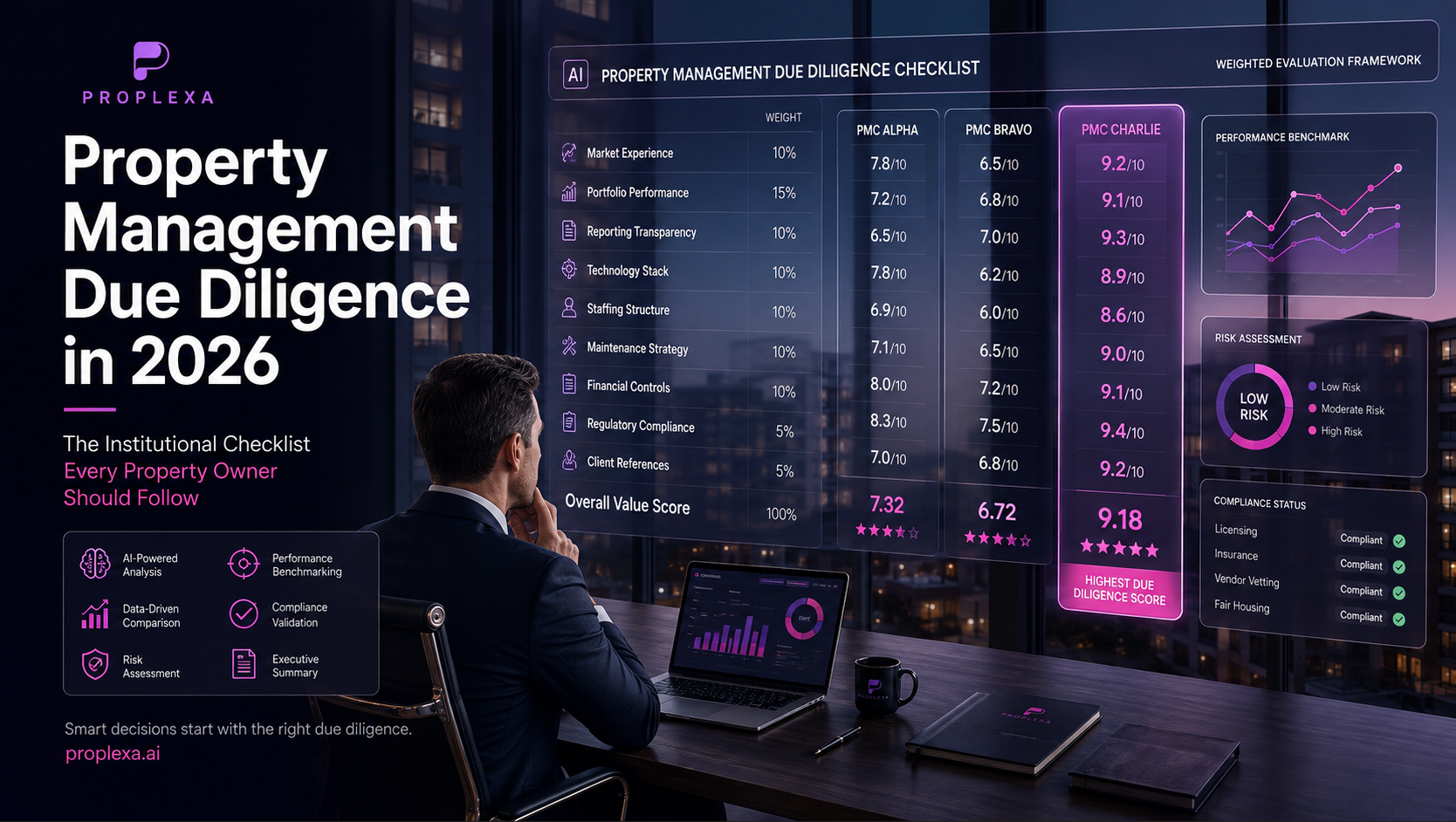
Institutional investors increasingly evaluate management companies using weighted scorecards.
Typical evaluation categories include:
- Operational performance.
- Technology.
- Financial reporting.
- Compliance.
- Market expertise.
- Resident satisfaction.
- Owner communication.
- Staffing quality.
- Pricing.
- Innovation.
The objective is not to identify the lowest-cost proposal.
It is to identify the highest long-term value.
Why Due Diligence Matters Even More in 2026
Several trends have increased the importance of selecting the right management partner:
- Elevated operating expenses.
- Continued insurance cost inflation.
- More demanding residents.
- Rapid AI adoption.
- Greater owner expectations for transparency.
- Increasing regulatory complexity.
As margins become tighter, operational excellence becomes a larger driver of investment performance.
The difference between an average operator and an exceptional one has never been more measurable.
How Proplexa Simplifies Due Diligence
Traditional manager selection often relies on referrals, personal networks, or isolated conversations.
That process makes objective comparison difficult.
Proplexa changes that.
Property owners can receive multiple proposals from vetted property management companies and evaluate them side by side across pricing, experience, technology, operational capabilities, reporting standards, and overall value.
Instead of relying on intuition, owners can make data-driven decisions supported by structured comparisons.
Final Thoughts
Institutional investors understand a simple principle:
Every major investment deserves rigorous due diligence.
Property management should be no exception.
The right management company doesn't simply maintain a property.
It protects revenue.
Improves NOI.
Reduces risk.
Enhances resident experience.
And ultimately increases long-term asset value.
In 2026, disciplined due diligence isn't just a best practice.
It's a competitive advantage.