
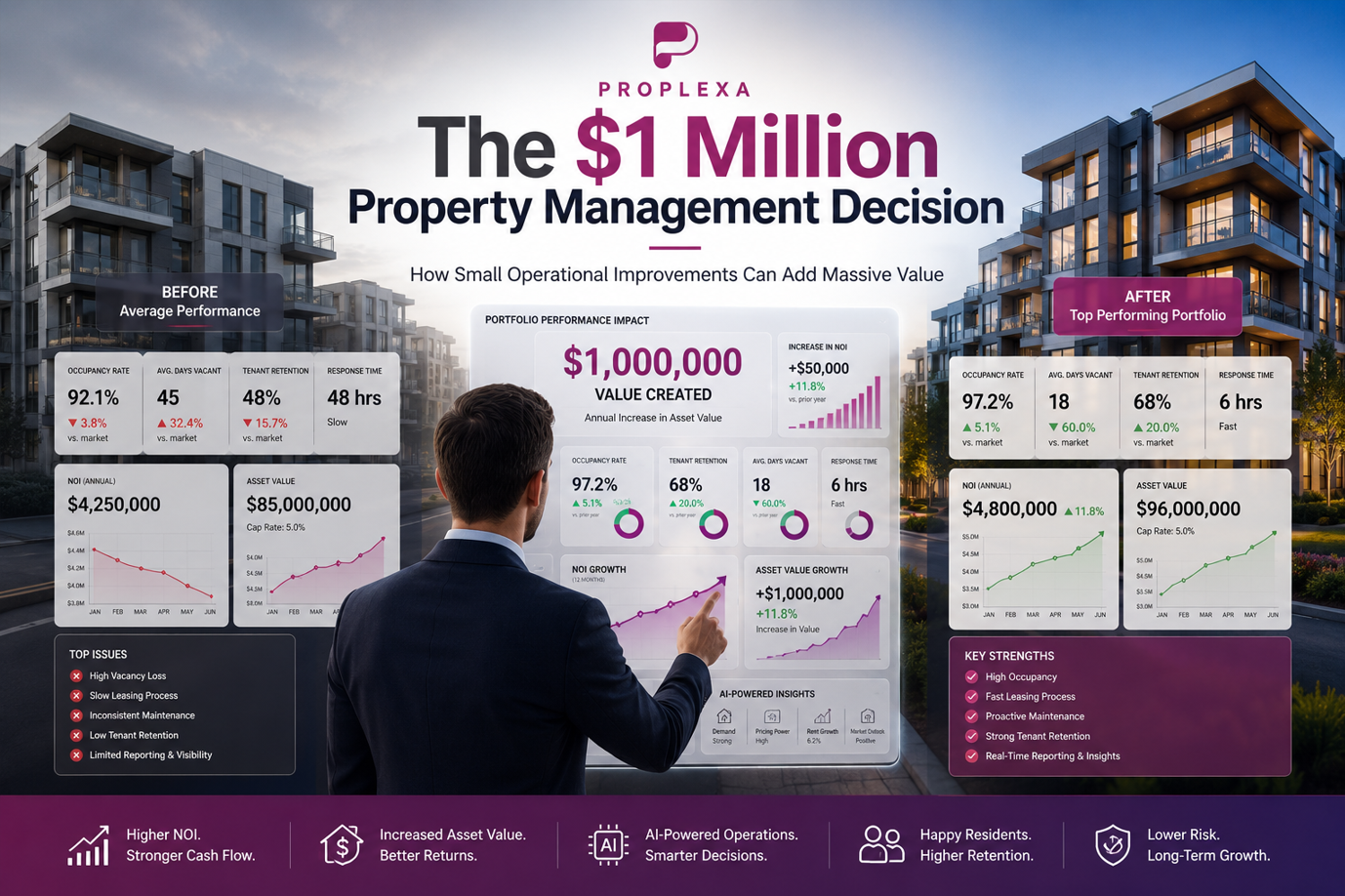
The $1 Million Property Management Decision Most Investors Don't Realize They're Making
Most real estate investors obsess over acquisitions.
They spend weeks analyzing:
- Purchase price
- Cap rates
- Financing terms
- Interest rates
- Market appreciation
Yet many overlook one factor that can have a larger impact on long-term returns:
Property management performance.
The reality is that property management doesn't just affect operations.
It affects asset value.
And in many cases, the difference can be worth hundreds of thousands—or even millions—of dollars.
Most Investors Think About Costs. The Best Investors Think About NOI.
The average owner evaluates management companies based on fees.
A company charges 4%.
Another charges 6%.
The lower fee often appears more attractive.
But sophisticated investors know that management fees are only one line item.
The metric that truly matters is:
Net Operating Income (NOI)
Because NOI directly influences asset value.
A small increase in NOI can create a disproportionately large increase in property valuation.
The Math Most Owners Never Calculate
Imagine a multifamily property generating:
$500,000 Annual NOI
Using a 5% capitalization rate:
Property Value = $10,000,000
Now assume better management achieves:
- Higher occupancy
- Faster leasing
- Better renewals
- Improved maintenance efficiency
- Better rent collection
Result:
NOI increases by $50,000 annually.
The property's value becomes:
$11,000,000
A $50,000 operational improvement created:
$1,000,000 in asset value.
Same property.
Same market.
Different execution.
The Occupancy Effect
Vacancy remains one of the largest profit leaks in rental housing.
Consider a 150-unit apartment community.
Average rent:
$2,000/month
Improving occupancy from:
93% → 97%
Produces approximately:
$144,000 in additional annual revenue.
Without purchasing another property.
Without raising rents.
Without increasing leverage.
Just better operations.
Why Renewals Matter More Than Rent Increases
Many owners focus on increasing rents.
Leading operators increasingly focus on reducing turnover.
Turnover creates:
- Lost rent
- Unit preparation costs
- Marketing expenses
- Leasing costs
- Administrative work
Industry studies consistently show that retaining residents is significantly less expensive than replacing them.
A property with stronger renewal performance often produces superior NOI growth even if rent increases are modest.
Resident Experience Is Becoming a Financial Metric
The property management industry is undergoing a major shift.
Historically, management companies focused on:
- Rent collection
- Maintenance coordination
- Financial reporting
Today, resident experience has become a primary driver of operational performance.
Why?
Because resident experience influences:
- Retention
- Online reputation
- Referrals
- Occupancy
- Revenue
The connection is increasingly measurable.
Satisfied residents stay longer.
Longer stays reduce turnover.
Lower turnover improves NOI.
Improved NOI increases asset value.
Technology Is Creating a New Class of Operators
One of the biggest industry developments in 2026 is the rapid adoption of operational technology.
Forward-thinking management companies now utilize:
AI-Assisted Leasing
Responding to prospects faster.
Predictive Maintenance Systems
Reducing expensive emergency repairs.
Automated Resident Communications
Improving satisfaction and response times.
Advanced Reporting Dashboards
Giving owners greater transparency into portfolio performance.
The result is a growing divide between technology-enabled operators and traditional operators.
Institutional Investors Already Understand This
Private equity firms, REITs, and institutional real estate owners rarely select managers based solely on fees.
Instead, they focus on:
- Occupancy performance
- Renewal rates
- Reporting quality
- Operational scalability
- Historical results
Why?
Because they understand a fundamental truth:
Better management creates better assets.
The same logic increasingly applies to individual investors and small portfolio owners.
The Hidden Opportunity in Every Portfolio
Most investors immediately recognize acquisition opportunities.
Fewer recognize operational opportunities.
Yet operational improvements often require:
- Less capital
- Less risk
- Faster implementation
Improving occupancy.
Improving renewals.
Improving maintenance response times.
Improving resident satisfaction.
These are often the highest-return investments available to property owners.
Why This Matters More in 2026
The rental housing industry is becoming more competitive.
Operating expenses remain elevated.
Residents have higher expectations.
Technology adoption is accelerating.
As a result, the difference between average and top-performing operators continues to grow.
The owners who focus exclusively on acquisition strategy may miss one of the largest value creation opportunities available today:
Operational excellence.
How Proplexa Helps Owners Capture More Value
Choosing the right property management company is one of the most important financial decisions a property owner makes.
Yet historically, comparing management companies has been fragmented and opaque.
Proplexa was built to solve this problem.
By enabling property owners to receive, compare, and evaluate multiple management proposals in one place, Proplexa helps investors make more informed decisions about the teams responsible for operating their assets.
Because ultimately:
The right property manager doesn't just manage a property.
They help maximize its value.
Final Thoughts
Most investors spend enormous energy negotiating purchase prices.
Few spend the same energy evaluating the company responsible for operating the asset after closing.
That may be a mistake.
Because in 2026, the difference between average and exceptional property management is increasingly measurable in dollars—not percentages.
And sometimes, that difference is worth millions.