
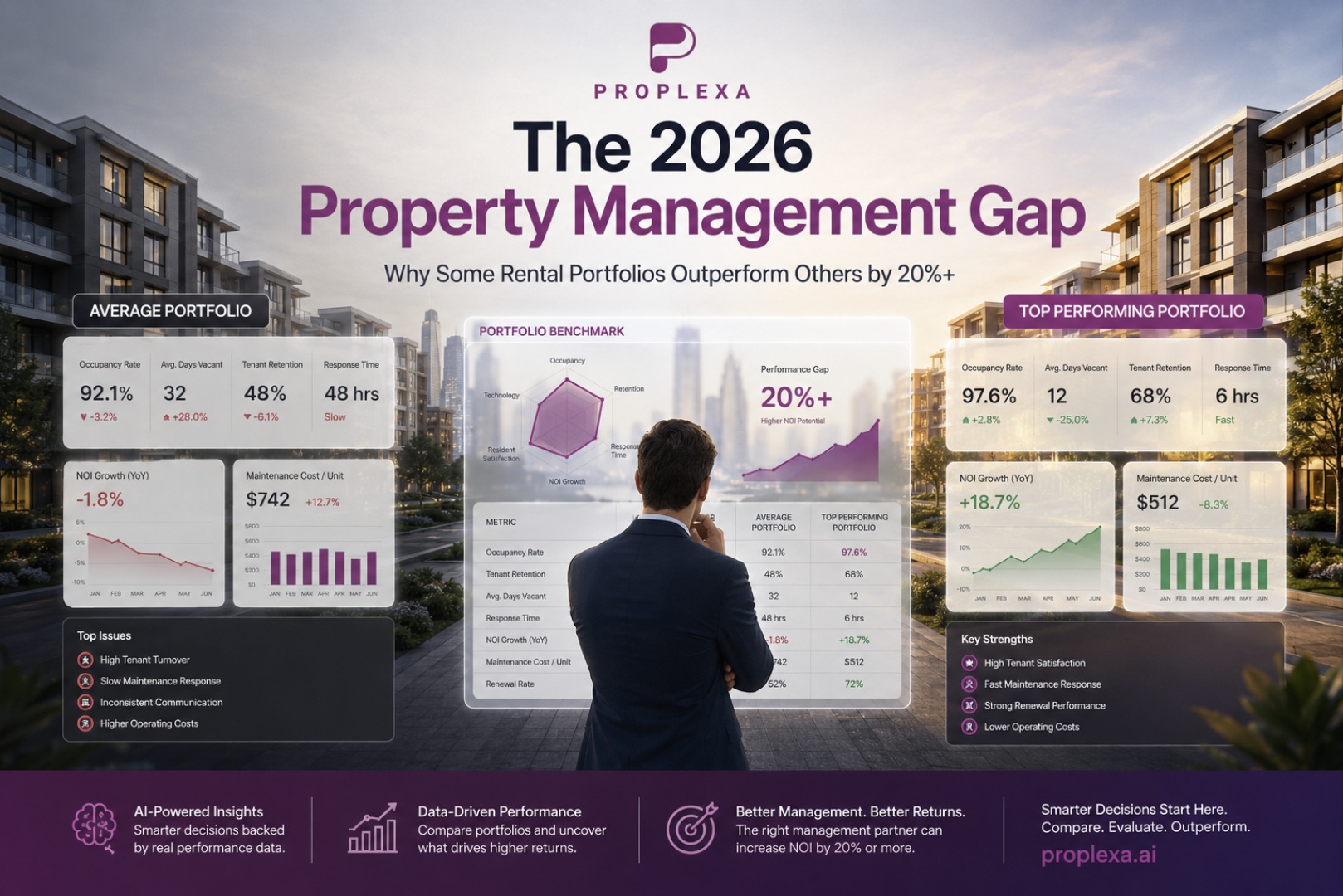
The 2026 Property Management Gap: Why Some Rental Portfolios Outperform Others by 20%+
For years, real estate investors have focused on acquisition.
Find a good property.
Buy below market value.
Increase rents.
Refinance.
Repeat.
But in 2026, a growing number of investors are discovering a new reality:
Operational performance is becoming just as important as acquisition strategy.
Two apartment communities can sit across the street from each other.
Same market.
Similar demographics.
Similar rents.
Similar property age.
Yet one consistently outperforms the other.
Why?
Because today's competitive advantage is increasingly operational.
And a growing body of industry data suggests the performance gap between average and top-performing portfolios is widening.
The Rise of the Operational Advantage
Historically, location was considered the primary driver of rental performance.
Location still matters.
But operational execution now plays a larger role than ever before.
Industry surveys conducted during 2025 and 2026 show that property owners are placing greater emphasis on:
Tenant retention
Resident experience
Speed of maintenance response
Technology adoption
Data reporting
Communication quality
Operational transparency
At the same time, renters themselves have become more demanding.
They expect:
Faster responses
Better digital experiences
Easier communication
More professional management
Properties that fail to meet these expectations increasingly struggle with turnover and vacancies.
The Occupancy Gap Is Growing
One of the most important metrics in real estate is occupancy.
A seemingly small difference can dramatically impact annual returns.
Consider a 200-unit portfolio.
Property A operates at:
97% occupancy
Property B operates at:
92% occupancy
The difference?
10 additional vacant units at any given time.
At an average rent of $1,800 per month, that's:
$216,000 in annual revenue difference.
Same market.
Different execution.
This is why sophisticated investors increasingly view occupancy as an operational metric—not simply a market metric.
Speed Has Become a Financial Metric
The traditional property management industry focused heavily on rent collection.
Today's leaders focus on response times.
Why?
Because response times affect resident satisfaction.
Resident satisfaction affects renewals.
Renewals affect occupancy.
Occupancy affects NOI.
The chain reaction is direct.
Recent industry reports show that resident experience is now among the top strategic priorities for leading property management organizations.
The companies that respond faster are increasingly retaining residents longer.
And longer tenant retention often translates directly into stronger property performance.
The Technology Divide Is Accelerating
One of the most interesting findings emerging from 2026 industry data is the growing technology divide.
According to recent property management industry research, AI adoption among management companies increased from approximately 20% to 58% in just one year.
But adoption alone isn't the story.
The real story is performance.
Top-performing companies are leveraging technology to:
Automate leasing workflows
Improve maintenance coordination
Reduce administrative overhead
Improve communication consistency
Deliver faster reporting
As a result, many firms are scaling more efficiently while maintaining service quality.
This creates a widening performance gap between technology-enabled operators and traditional operators.
Retention Is the New Revenue Growth
Many investors focus on raising rents.
But the highest-performing portfolios increasingly focus on retention.
Why?
Because replacing tenants is expensive.
Turnover creates:
Vacancy loss
Marketing expenses
Cleaning costs
Maintenance expenses
Administrative costs
A resident who stays another year may generate more value than a rent increase alone.
This is why leading operators increasingly measure renewal rates as closely as occupancy rates.
Retention has become one of the most overlooked drivers of NOI.
The Most Valuable Question Investors Should Ask
When evaluating a property management company, many owners ask:
"What are your fees?"
The better question may be:
"How do your clients perform compared to market averages?"
Because ultimately:
A management fee impacts expenses.
Operational performance impacts revenue.
And revenue improvements typically have a greater effect on property value than small fee differences.
The best management companies understand this.
They don't compete on price.
They compete on results.
Why This Matters More in 2026
The rental housing market is becoming increasingly competitive.
Operating costs remain elevated.
Resident expectations continue rising.
Technology is changing the standard of service.
Meanwhile, investors are demanding greater visibility into performance metrics.
As a result, the difference between average and exceptional management is becoming easier to measure—and more valuable.
The era of choosing a property manager based solely on reputation or referrals is beginning to fade.
Data is becoming the deciding factor.
The Future Is Performance Transparency
Over the next decade, property owners will increasingly expect access to measurable operational data before selecting a management company.
They will want visibility into:
Occupancy performance
Renewal rates
Response times
Service quality
Portfolio experience
Operational benchmarks
This shift is already underway.
And it is creating opportunities for owners who embrace a more data-driven approach to property management selection.
How Proplexa Fits Into This Future
At Proplexa, we believe property owners deserve more than marketing promises.
They deserve transparency.
They deserve comparability.
And they deserve better information before making one of the most important decisions affecting their investment performance.
The future of property management will belong to owners who make decisions based on measurable value—not assumptions.
And the companies that can demonstrate performance will ultimately stand out from the competition.
Final Thoughts
The biggest difference between average and exceptional rental portfolio performance in 2026 isn't necessarily location.
It's execution.
As technology adoption accelerates and investor expectations evolve, operational excellence is becoming a primary driver of returns.
The owners who recognize this shift early will be better positioned to maximize occupancy, improve retention, and grow portfolio value in the years ahead.