
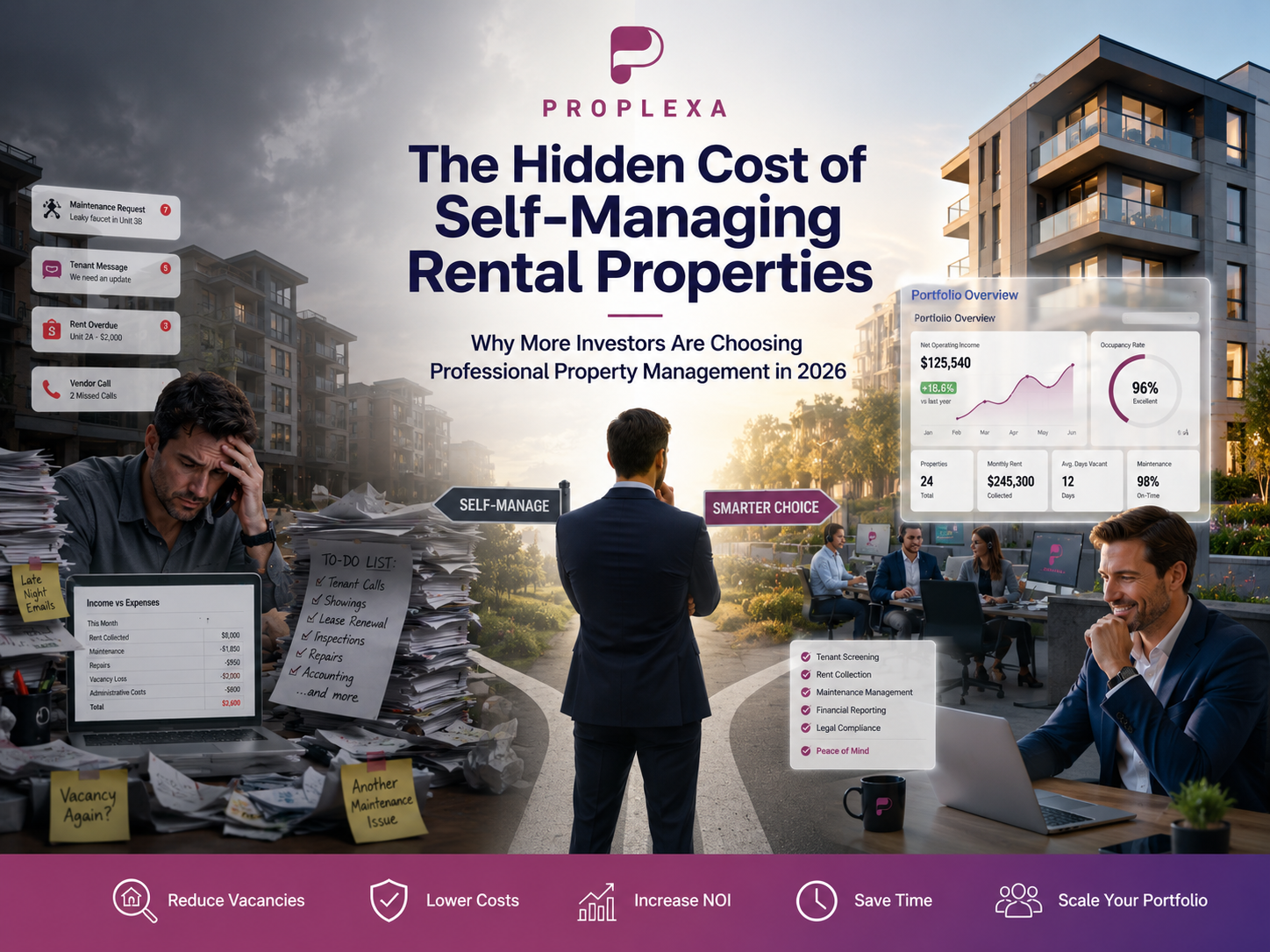
The Hidden Cost of Self-Managing Rental Properties in 2026
For many real estate investors, self-managing rental properties feels like the logical choice.
After all, why pay management fees when you can handle leasing, maintenance coordination, tenant communication, rent collection, and vendor relationships yourself?
The answer is simple:
Because your time has value.
And in 2026, the most successful investors are increasingly viewing property management not as an expense, but as a growth strategy.
The real cost of self-management isn't the money you spend.
It's the money you never earn.
The Myth of "Saving" Property Management Fees
Many landlords focus exclusively on the visible cost of hiring a property management company.
Typically, management fees range from 6% to 12% of collected rent depending on the market and services provided.
On the surface, self-management appears to preserve that revenue.
But this calculation often ignores:
- Vacancy costs
- Maintenance inefficiencies
- Tenant turnover
- Legal and compliance risks
- Missed rent increases
- Lost acquisition opportunities
- Time spent on administrative tasks
Professional investors understand that maximizing net operating income (NOI) is not simply about reducing expenses—it's about optimizing performance across the entire portfolio.
Vacancy Is Often the Most Expensive Cost
Most landlords focus heavily on management fees while underestimating vacancy losses.
Consider a property renting for $2,000 per month.
Just one additional month of vacancy equals:
$2,000 in lost revenue
That single vacancy period can easily exceed an entire year's worth of management fees.
Professional property managers typically maintain systems, vendor networks, marketing processes, and leasing workflows designed to reduce downtime between tenants.
In competitive rental markets, speed matters.
A property sitting vacant for 30 extra days can erase months of expected cash flow.
Tenant Retention Is Becoming a Competitive Advantage
The economics of rental housing have changed.
Replacing a tenant is expensive.
The process often includes:
- Cleaning
- Repairs
- Marketing
- Showings
- Screening
- Lease preparation
- Vacancy loss
Industry research shows that property owners and residents increasingly expect faster communication, better service experiences, and more responsive maintenance than ever before. These expectations are becoming a major factor in tenant satisfaction and retention.
The reality is simple:
Happy tenants stay longer.
Longer stays generally produce:
- Lower turnover costs
- Lower vacancy rates
- More predictable cash flow
- Higher long-term returns
Time Is an Investment Asset
Many investors never calculate the value of their own time.
Answering maintenance calls.
Coordinating vendors.
Managing lease renewals.
Handling accounting.
Resolving tenant disputes.
Processing applications.
Individually, each task may seem manageable.
Collectively, they can consume hundreds of hours annually.
For investors seeking portfolio growth, those hours may be far more valuable when spent:
- Acquiring new properties
- Raising capital
- Improving financing structures
- Evaluating new markets
- Building strategic partnerships
The question isn't whether you can self-manage.
The question is whether that's the highest-value use of your time.
Technology Is Raising the Standard
The property management industry is undergoing one of the largest technology transformations in its history.
According to Buildium's 2026 State of the Property Management Industry Report, AI adoption among property management companies increased from 20% to 58% in a single year. However, only a small percentage of firms have fully automated workflows, meaning the industry is still in the early stages of transformation.
Leading management companies are using technology to:
- Improve response times
- Streamline maintenance workflows
- Automate communications
- Improve reporting
- Increase operational efficiency
Property owners increasingly benefit from these systems without having to build them themselves.
The Biggest Cost: Missed Growth Opportunities
This is the hidden cost most investors never measure.
Imagine two investors who each own five rental properties.
Investor A spends 15–20 hours every week managing operations.
Investor B hires professional management and spends those hours sourcing acquisitions and building relationships.
Five years later, which investor is more likely to own ten properties?
Or twenty?
The greatest value of professional property management is often not operational.
It's strategic.
It allows investors to focus on growing wealth instead of running day-to-day operations.
Why This Trend Is Accelerating in 2026
The property management industry is becoming more sophisticated.
Owners expect transparency.
Tenants expect faster service.
Regulations continue evolving.
Technology is changing operating standards.
Meanwhile, institutional investors and large portfolio owners continue increasing their reliance on professional management partners because operational excellence has become a competitive advantage. The growing interest of private equity firms in property management businesses further highlights the strategic value being created within the sector.
More independent investors are beginning to follow the same path.
Finding the Right Property Management Company Matters
Of course, not all property management companies are equal.
The challenge for many property owners is knowing:
- Which companies specialize in their asset type?
- Which have experience in their market?
- Which offer the right level of service?
- Which align with their investment goals?
This is exactly where modern marketplaces like Proplexa create value.
Instead of spending weeks researching options individually, property owners can discover, compare, and connect with qualified property management companies more efficiently.
The goal isn't simply to outsource management.
It's to make better management decisions.
Final Thoughts
The question for investors in 2026 is no longer:
"Can I manage this property myself?"
The better question is:
"What is my time worth, and what opportunities am I missing by focusing on operations instead of growth?"
For many investors, the answer is becoming increasingly clear.
The most valuable asset in a real estate portfolio isn't the property.
It's the ability to scale.
And often, professional property management is what makes that possible.