
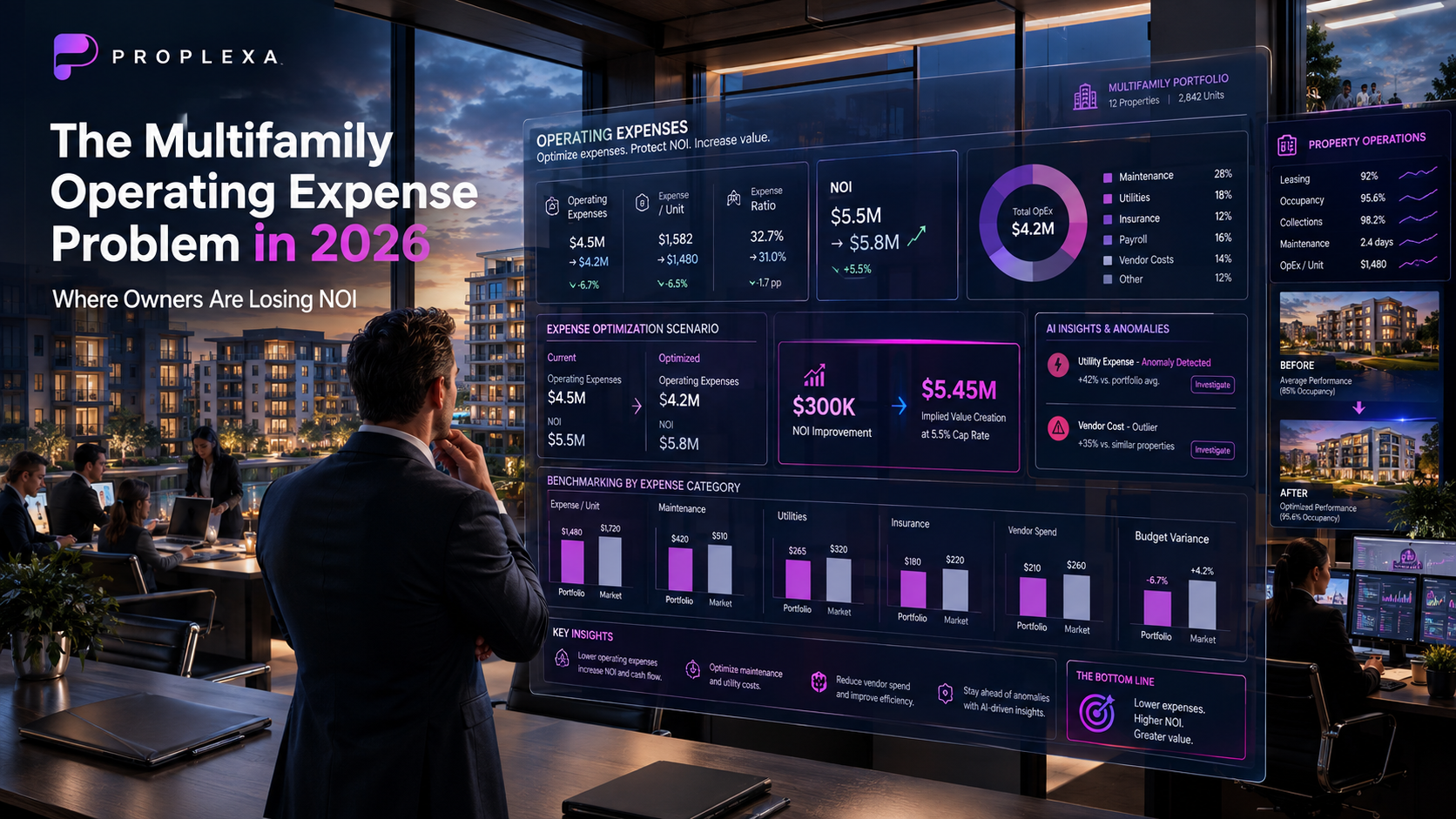
For multifamily investors, revenue gets most of the attention.
Owners track:
- Rent growth
- Occupancy
- Lease-up velocity
- Renewals
- Concessions
- Effective rents
But there's another side of the income statement that deserves equal attention.
Operating expenses.
Because every dollar that leaks out of a property's operating budget reduces NOI.
And because multifamily assets are commonly valued based on NOI, an expense problem can become a valuation problem.
This is particularly relevant in 2026.
CBRE's 2026 multifamily outlook describes a market where rent growth remains relatively modest while operators prioritize occupancy and renewals. Its midyear forecast puts 2026 rent growth at approximately 1.4% and vacancy at 4.9%.
When top-line growth is moderate, expense discipline becomes increasingly important.
Revenue Growth Is Only Half of the NOI Equation
The basic relationship is straightforward:
NOI = Effective Gross Income − Operating Expenses
An owner can increase revenue and still experience disappointing NOI growth if expenses rise faster.
Consider a simplified example.
Annual effective gross income:
$10,000,000
Operating expenses:
$4,000,000
NOI:
$6,000,000
Now assume revenue increases by 3%.
New revenue:
$10,300,000
That sounds positive.
But suppose operating expenses increase by 5%.
New expenses:
$4,200,000
New NOI:
$6,100,000
Revenue increased:
$300,000
But NOI increased only:
$100,000
The difference is expense growth.
This is why sophisticated operators don't simply ask:
"How fast is revenue growing?"
They ask:
"How efficiently is revenue being converted into NOI?"
What Counts as a Multifamily Operating Expense?
Under Fannie Mae's multifamily underwriting framework, stabilized operating expenses are analyzed on a line-by-line basis.
Relevant categories include:
- Property management
- Real estate taxes
- Insurance
- Utilities
- Water and sewer
- Repairs and maintenance
- Payroll and benefits
- Advertising and marketing
- Professional fees
- General and administrative expenses
- Other property-level expenses
Fannie Mae specifically requires analysis of historical operations, contracts, utility bills, tax assessments, insurance policies, comparable properties and the borrower's budget when determining stabilized operating expenses.
That level of granularity matters.
Because "operating expenses" is not one number.
It is a collection of hundreds or thousands of individual decisions.
The Five Expense Categories Owners Should Watch Closely
For most multifamily portfolios, five areas deserve particularly close attention:
1. Repairs & Maintenance
2. Utilities
3. Insurance
4. Payroll & Staffing
5. Vendor and Contract Services
And there is an important common factor:
Property management influences every one of them.
1. Repairs & Maintenance: The Expense You Can Often Influence Operationally
Maintenance is not simply a cost center.
It is an operating system.
Poor maintenance processes can produce:
- Emergency repairs
- Repeat work orders
- Longer unit downtime
- Higher contractor costs
- Resident dissatisfaction
- Increased turnover
- More expensive replacements
A strong maintenance operation attempts to move the organization from:
Reactive maintenance
to:
Preventive + predictive maintenance
The distinction matters.
Reactive maintenance asks:
"What broke?"
Preventive maintenance asks:
"What should we service before it breaks?"
Predictive maintenance asks:
"What is likely to fail next?"
The third approach is increasingly enabled by data and technology.
Maintenance Has a Revenue Impact Too
Suppose a 200-unit community experiences 20 additional days of vacancy because of delayed turns.
Average rent:
$2,000/month
Approximate daily rent:
$65.75
Twenty days of lost rent represents approximately:
$1,315 per unit
Across 10 affected units:
$13,150
That's before considering:
- Maintenance labor
- Materials
- Marketing
- Leasing costs
- Concessions
The maintenance department therefore affects more than the maintenance line item.
It can affect revenue.
2. Utilities: The Expense That Can Hide in Plain Sight
Utilities can become one of the most difficult operating expenses to manage because consumption is distributed across:
- Individual units
- Common areas
- HVAC systems
- Water systems
- Lighting
- Pools
- Parking areas
- Landscaping
- Building infrastructure
Fannie Mae's underwriting framework explicitly identifies electricity, fuel, heat, natural gas, trash removal, vacant-unit utilities, water and sewer among property operating expenses.
The operational challenge is therefore not simply reducing consumption.
It is identifying where consumption is occurring.
The Importance of Benchmarking Utilities
Suppose two 300-unit communities have similar occupancy.
Property A:
$1,100/unit/year
Property B:
$1,450/unit/year
The difference is:
$350/unit/year
Across 300 units:
$105,000 annually
The question isn't automatically:
"Why is Property B inefficient?"
There could be legitimate differences involving:
- Climate
- Building age
- Utility structure
- Water billing
- HVAC systems
- Amenities
- Unit mix
But the variance should trigger investigation.
Benchmarking turns an expense into a question.
3. Insurance: A Structural Cost Pressure
Insurance deserves particular attention in 2026.
Freddie Mac noted that commercial property insurance markets experienced significant strain, with premiums increasing by 10% to 20% year over year during the period when the market was under particularly heavy pressure.
The insurance environment has also led to changes in multifamily insurance requirements.
Freddie Mac updated its multifamily insurance requirements in July 2026, including changes affecting carrier ratings, flood deductibles and terrorism coverage.
For property owners, this means insurance should not simply be treated as a fixed annual budget line.
It deserves active management.
Insurance Management Goes Beyond Finding a Lower Premium
Property managers can help owners evaluate:
- Claims history
- Deductibles
- Coverage limits
- Policy exclusions
- Replacement-cost assumptions
- Property-level risk
- Carrier requirements
- Renewal timing
- Loss-control recommendations
The cheapest policy isn't necessarily the most economically appropriate policy.
The objective is:
Risk-adjusted cost efficiency.
4. Payroll: Efficiency Without Sacrificing Service
Labor is another major component of property operations.
The challenge is balancing:
Service quality
with:
Labor efficiency
Understaffing can create:
- Slow maintenance response
- Poor resident communication
- Leasing delays
- Administrative backlogs
- Employee burnout
- Lower resident satisfaction
Overstaffing can create:
- Excess payroll
- Low productivity
- Higher operating expense ratios
The optimal structure depends on:
- Unit count
- Property type
- Asset class
- Geographic dispersion
- Amenities
- Resident profile
- Technology
- Service model
There is no universal staffing ratio.
That's precisely why owners should benchmark actual performance instead of applying generic rules.
5. Vendor Management: The Forgotten NOI Lever
A multifamily property may work with dozens of vendors.
Examples include:
- HVAC
- Plumbing
- Electrical
- Landscaping
- Pest control
- Cleaning
- Security
- Waste management
- Pool maintenance
- Elevator services
- Flooring
- Painting
- Turnover contractors
Each contract may appear relatively small.
Collectively, they can represent millions of dollars across a portfolio.
This creates an opportunity.
Procurement Is Not Just About Negotiating Price
A sophisticated vendor-management strategy evaluates:
Price
Quality
Response time
Warranty
Frequency
Scope
Performance
Contract terms
A contractor that charges 10% less but produces significantly more callbacks may actually be more expensive.
The relevant metric is therefore:
Total cost of ownership
rather than simply invoice price.
The Hidden Cost of Poor Vendor Management
Imagine a portfolio spends:
$2 million annually
on repairs and contracted services.
If poor procurement and vendor controls create just a hypothetical:
5% efficiency gap
the economic impact would be:
$100,000 annually
At a 6% capitalization rate, $100,000 of recurring NOI represents approximately:
$1.67 million of implied property value.
The exact result depends on the asset's capitalization rate and whether the savings are truly sustainable.
But the valuation mechanism is real.
Expense Ratio Matters
One of the most useful ways to benchmark property operating performance is through the operating expense ratio.
The simplified formula is:
Operating Expense Ratio = Operating Expenses ÷ Effective Gross Income
Suppose:
Effective gross income:
$10M
Operating expenses:
$4M
Expense ratio:
40%
Now another property generates the same revenue but has:
$4.5M
of operating expenses.
Its expense ratio is:
45%
The second property is converting less revenue into NOI.
But again, the comparison must be normalized.
Different markets and asset types can have very different cost structures.
Why Cost Per Unit Is Also Important
Another useful benchmark is:
Operating Expense per Unit
Suppose a 500-unit portfolio has:
$4 million
of annual operating expenses.
Expense per unit:
$8,000
Now compare it with a similar portfolio at:
$7,400 per unit
The difference:
$600 per unit
Across 500 units:
$300,000 annually
This provides a much clearer operational signal than simply looking at total expenses.
But Per-Unit Metrics Can Mislead
This is where professional underwriting becomes important.
A luxury property with:
- Concierge service
- Fitness center
- Pool
- Clubhouse
- Valet services
will naturally have a different expense profile from a workforce-housing property with limited amenities.
Therefore, investors should benchmark against:
- Similar asset class
- Similar vintage
- Similar market
- Similar unit count
- Similar amenity package
- Similar operating model
Comparable-property benchmarking is more meaningful than generic averages.
Stabilized Expenses vs. Temporary Expenses
This distinction is critical for investors.
Fannie Mae defines stabilized operating expenses as expenses associated with normal ongoing property operations and excludes non-recurring or extraordinary expenses from stabilized underwriting.
Consider:
A property experiences:
$300,000
of one-time storm repairs.
That should not automatically become the basis for assuming:
$300,000 every year.
Conversely, an owner should not classify recurring maintenance problems as "one-time" simply because they were inconvenient.
Good underwriting separates:
Recurring operating expenses
from:
Non-recurring events.
The Danger of Underestimating Expenses During Acquisition
This is where operating expense management becomes an acquisition issue.
Suppose an acquisition model assumes:
Operating expenses:
$4M
Actual stabilized expenses become:
$4.5M
That's a:
$500,000 NOI shortfall
At a 5.5% cap rate, the corresponding valuation difference is approximately:
$9.1 million.
This is why expense assumptions matter before closing—not just after.
Expense Growth Should Be Stress-Tested
A professional underwriting model should not rely on one expense-growth assumption.
For example:
Base Case
Expense growth:
3%
Moderate Stress
Expense growth:
5%
Severe Stress
Expense growth:
7%
The goal isn't to predict which scenario will happen.
It's to understand the investment's sensitivity.
CBRE underwriting materials published for 2026 include a 3% expense-growth assumption in a five-year analysis, illustrating how expense escalation is explicitly incorporated into professional property-level underwriting.
Why Expense Control Is Becoming More Important in 2026
The multifamily market is not operating in an environment where owners can simply assume aggressive rent growth.
CBRE's midyear 2026 outlook projects:
1.4% average annual rent growth
and approximately:
4.9% vacancy
for 2026.
Yardi's May 2026 data similarly showed national advertised multifamily rents at approximately $1,767, up only 0.2% year over year.
When top-line growth is relatively constrained, operational efficiency becomes more valuable.
An owner may not be able to force the market to produce 6% rent growth.
But management can influence:
- Collection efficiency
- Turnover
- Maintenance
- Vendor performance
- Staffing
- Utilities
- Marketing efficiency
- Administrative processes
The Expense-to-NOI Multiplier
Here's the part every investor should understand.
Suppose a property has:
$1,000,000 NOI
and an owner finds:
$100,000
of sustainable annual expense savings.
New NOI:
$1.1M
At a:
5.5% cap rate
The incremental value is approximately:
$1.82 million
The owner didn't need to purchase another building.
The value came from improving the economics of the existing asset.
But Cost Cutting Can Destroy NOI
This distinction is extremely important.
Expense optimization is not the same thing as expense minimization.
Cutting maintenance too aggressively can increase:
- Deferred maintenance
- Resident complaints
- Turnover
- Emergency repairs
- Reputation problems
Cutting leasing staff can reduce:
- Response speed
- Conversion
- Occupancy
Cutting resident services can increase:
- Churn
- Negative reviews
- Renewal losses
Therefore:
The objective is not the lowest operating expense.
It is:
The highest sustainable NOI at an appropriate level of service and risk.
The New Property Management Scorecard
In 2026, owners should evaluate property managers across at least five operational dimensions:
Revenue Management
- Effective rent
- Occupancy
- Concessions
- Renewal performance
Expense Management
- Expense per unit
- Expense ratio
- Vendor costs
- Utility consumption
Maintenance
- Response time
- Completion time
- Cost per work order
- Preventive maintenance
Resident Experience
- Renewal rate
- Satisfaction
- Complaints
- Reviews
Financial Controls
- Budget variance
- Forecast accuracy
- Reporting quality
- Invoice controls
This creates a much more complete picture than simply comparing management fees.
Technology Is Becoming an Expense-Control Tool
Technology should not be adopted merely because it looks modern.
The relevant question is:
Does it improve economics?
Useful technologies can help with:
Predictive maintenance
Identify potential equipment failures before they become emergencies.
Automated invoice processing
Reduce administrative workload and improve financial controls.
Utility monitoring
Identify abnormal consumption.
Vendor benchmarking
Compare costs across properties and markets.
AI-assisted leasing
Increase response speed without requiring proportional staffing increases.
Portfolio dashboards
Identify expense anomalies across hundreds of units.
The objective is not technology adoption.
The objective is:
Operational leverage.
What Investors Should Ask Property Managers
Before selecting a property management company, owners should ask:
"How do you benchmark operating expenses?"
"What is your average maintenance cost per unit?"
"How do you evaluate vendors?"
"How frequently do you rebid contracts?"
"How do you identify utility anomalies?"
"What percentage of maintenance is preventive?"
"How do you measure budget variance?"
"What technology do you use to control expenses?"
"How do you report property-level expense performance?"
"Can you demonstrate measurable NOI improvement?"
These questions reveal considerably more than:
"What is your management fee?"
What Proplexa Changes
The property management industry has historically made it difficult for owners to compare operators on a consistent basis.
One company may emphasize:
Low fees.
Another:
Technology.
Another:
Experience.
Another:
Service.
The challenge is translating those claims into comparable economic criteria.
That's where a competitive marketplace can help.
Proplexa enables property owners to receive and compare management proposals from property management companies.
Instead of evaluating a manager solely on price, owners can examine a broader set of factors:
- Services
- Pricing
- Technology
- Operational capabilities
- Experience
- Reporting
- Performance expectations
The objective is not simply to reduce management costs.
It is to identify the operating partner capable of producing the strongest overall property-level outcome.
The Bottom Line
Multifamily owners don't lose NOI only when rents decline.
They also lose NOI through thousands of small operational inefficiencies.
A maintenance contract that is never rebid.
A utility bill that isn't benchmarked.
A vendor that consistently produces callbacks.
A unit that takes too long to turn.
A staffing structure that doesn't match the property's needs.
An insurance policy that isn't actively reviewed.
Individually, these issues may look insignificant.
Across hundreds or thousands of units, they compound.
And because NOI is a fundamental component of income-property valuation, operating efficiency ultimately becomes an asset-value issue.
The most sophisticated property owners therefore don't ask:
"How much does property management cost?"
They ask:
"How efficiently is my property being operated?"
In 2026, that may be the more important question.