
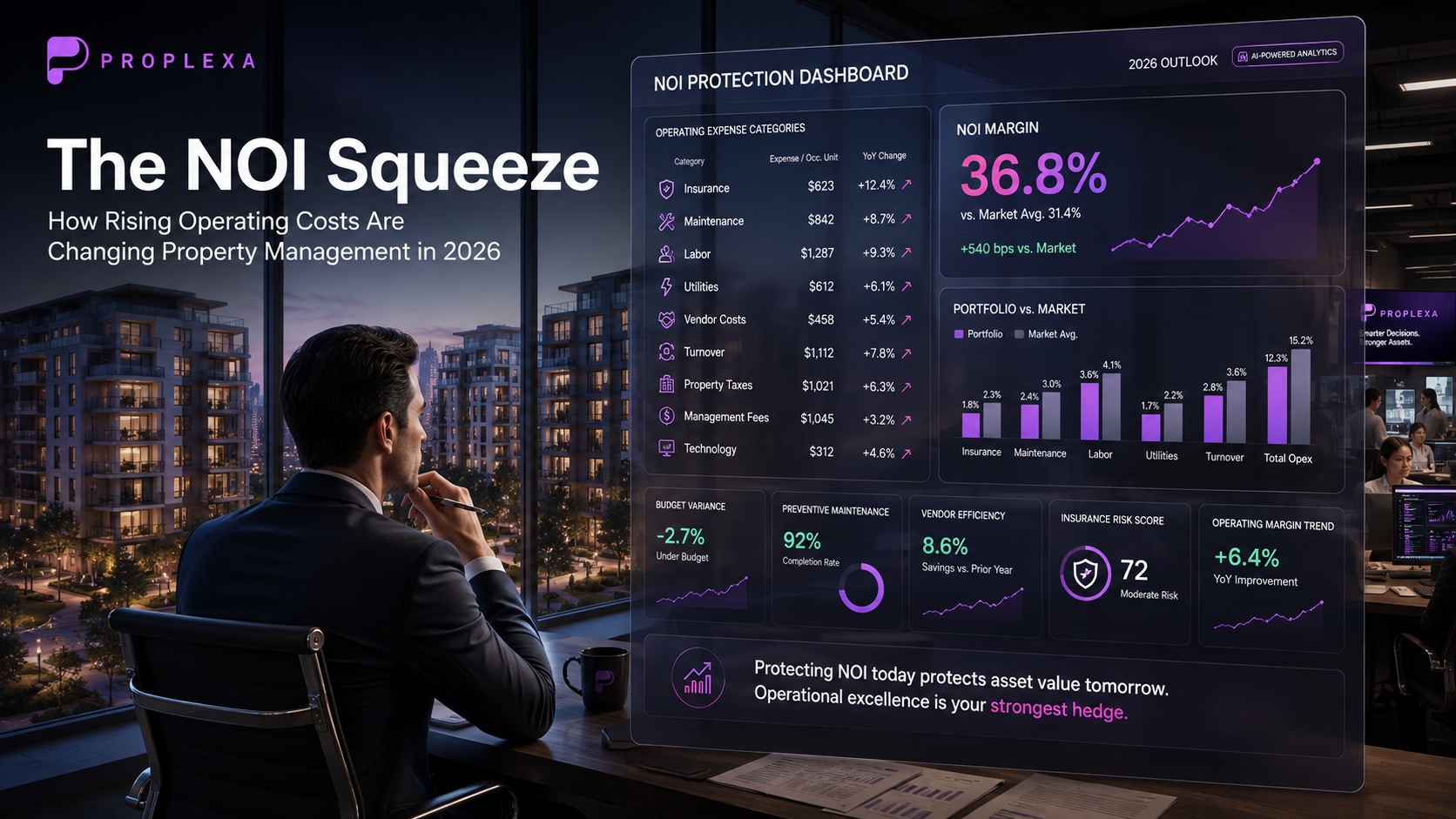
For years, multifamily investors could rely on a relatively simple formula:
Grow rents. Maintain occupancy. Control expenses.
In 2026, that formula is becoming considerably harder.
The U.S. multifamily market is stabilizing, but operators are facing a more complicated operating environment. CBRE reported that national multifamily vacancy fell to 4.8% in Q1 2026, while average monthly rent reached $2,217. At the same time, CBRE expects rent growth to remain relatively subdued in many markets as operators work through remaining supply.
That creates a fundamental challenge:
When revenue growth is limited, expense management becomes even more important.
For property owners, this means property management is no longer simply about collecting rent and coordinating maintenance.
It is increasingly about protecting the NOI margin.
The New Multifamily Equation
A property's financial performance is ultimately determined by the relationship between revenue and operating expenses.
When revenue grows rapidly, inefficient operations can sometimes remain hidden.
When revenue growth slows, those inefficiencies become much easier to see.
Consider two identical properties.
Both generate $3 million in annual revenue.
Property A operates with $1.2 million in expenses.
Property B operates with $1.35 million.
The difference is:
$150,000 of annual NOI.
That isn't an accounting detail.
At a 5% capitalization rate, a persistent $150,000 NOI difference represents approximately:
$3 million of implied asset value.
This is why expense management deserves the same strategic attention as rent growth.
The Operating Cost Problem Is Bigger Than Management Fees
When owners evaluate property managers, one of the first questions is often:
"What percentage do you charge?"
That's understandable.
But the management fee is only one component of the property's cost structure.
A more sophisticated analysis considers:
- Payroll
- Repairs and maintenance
- Utilities
- Insurance
- Property taxes
- Administrative expenses
- Turnover costs
- Leasing expenses
- Vendor contracts
- Technology
- Bad debt
- Management fees
IREM's Income/Expense IQ data illustrates how significant operating costs are relative to rental income. Its national 2023 benchmark showed multifamily communities averaging $8,420 in total operating expenses per unit, equivalent to approximately 41% of total gross rents.
The lesson is straightforward:
A small improvement in operating efficiency can matter more than negotiating a fraction of a percentage point off the management fee.
Insurance Has Become a Strategic Asset Management Issue
Few operating expenses illustrate the new environment better than insurance.
Insurance is no longer simply an annual line item to be renewed.
It has become a strategic component of multifamily underwriting.
NMHC reported in a 2026 industry comment letter that a 2025 Federal Reserve Bank of Minneapolis survey found multifamily property insurance premiums had doubled on average since 2021. The burden has been particularly significant for affordable housing operators.
Freddie Mac has also highlighted the importance of keeping pace with changes in the commercial insurance market and updated its multifamily insurance requirements in 2026.
For owners, this changes the role of property management.
A capable operator should understand:
- Insurance renewal timelines
- Claims history
- Risk mitigation
- Property condition
- Vendor compliance
- Preventive maintenance
- Documentation
- Loss-control measures
Better operational discipline can help reduce avoidable risk—even though it cannot eliminate market-wide insurance pricing pressure.
Maintenance Is One of the Most Controllable Expenses
Maintenance is another area where property managers can create substantial differences in performance.
There are two fundamentally different approaches.
Reactive maintenance
Something breaks.
A resident complains.
A technician is dispatched.
The problem is repaired.
Preventive maintenance
Potential problems are identified before they become emergencies.
Equipment is inspected.
Building systems are monitored.
Scheduled maintenance is performed.
Replacement cycles are planned.
The second model is generally more compatible with institutional asset management.
IREM has highlighted preventive maintenance as increasingly important to sustainability, cost control and asset preservation in 2026.
The objective isn't simply to reduce today's repair bill.
It's to reduce the probability of tomorrow's expensive failure.
Vendor Management Can Become a Hidden NOI Lever
Property managers often control relationships with dozens of vendors.
Landscaping.
HVAC.
Plumbing.
Electrical.
Cleaning.
Security.
Pest control.
Turnover crews.
Small differences in procurement discipline can compound across hundreds or thousands of units.
Sophisticated operators should be able to answer:
- How are vendors selected?
- Are multiple bids required?
- Are contracts periodically renegotiated?
- Is vendor performance measured?
- Are insurance certificates verified?
- Are recurring expenses benchmarked?
- Are emergency markups monitored?
The goal isn't simply to find the cheapest vendor.
It is to optimize cost, quality, response time and reliability simultaneously.
Turnover Is an Operating Expense
A resident move-out doesn't appear solely as a vacancy problem.
It creates an entire chain of costs.
A typical turnover can involve:
- Lost rental income
- Cleaning
- Painting
- Repairs
- Flooring
- Marketing
- Leasing labor
- Administrative processing
- Utility costs
This is why retention and expense management are closely connected.
A property manager who improves renewal performance can potentially reduce both revenue loss and operating expenditure.
The Labor Question
Property management is still fundamentally a people-driven business.
Even with AI and automation, portfolios require:
- Property managers
- Leasing teams
- Maintenance professionals
- Regional managers
- Accounting staff
- Compliance personnel
The challenge isn't simply reducing headcount.
It is improving productivity per employee.
Technology can help automate repetitive activities such as:
- Prospect communication
- Appointment scheduling
- Resident notifications
- Work-order routing
- Reporting
- Data aggregation
This allows employees to spend more time on higher-value activities.
The strongest operators are therefore not necessarily those with the most technology.
They are the ones that combine technology + process + human judgment.
Expense Control Does Not Mean Cutting Costs Everywhere
This distinction is critical.
Aggressive cost cutting can actually destroy NOI.
For example:
Cutting maintenance staff may reduce payroll today.
But if response times deteriorate, resident satisfaction may decline.
That can increase turnover.
Turnover creates vacancy.
Vacancy reduces revenue.
Deferred maintenance can also increase future capital expenditure.
The objective is therefore not:
"Spend less."
The objective is:
"Spend intelligently."
The New Metric: Cost per Occupied Unit
One useful way to improve operating analysis is to normalize expenses.
Instead of looking only at:
Total maintenance expense
an owner can examine:
Maintenance expense per occupied unit
Similarly:
- Payroll per occupied unit
- Utilities per occupied unit
- Turnover cost per move-out
- Marketing cost per lease
- Maintenance cost per work order
Normalization makes comparisons between properties much more meaningful.
Benchmarking Changes the Conversation
A $9,000 annual operating expense per unit may sound high.
Or low.
Without context, it is impossible to know.
The better question is:
How does this property compare with similar assets in the same market?
IREM's Income/Expense IQ platform explicitly supports benchmarking by asset type and metropolitan area, including total income, operating expenses and NOI.
This is exactly why benchmarking is becoming increasingly important.
Owners don't need more numbers.
They need comparable numbers.
Property Managers Are Becoming Financial Operators
The role of the property manager is evolving.
Historically, success was often measured by:
- Occupancy
- Rent collection
- Maintenance
- Resident complaints
Today, sophisticated owners increasingly expect managers to understand:
- NOI
- Expense ratios
- Budget variance
- Revenue management
- Capital planning
- Insurance risk
- Vendor economics
- Portfolio benchmarking
The modern property manager is increasingly part operator, part financial analyst and part asset-management partner.
What This Means for Property Management Companies
This shift also creates an opportunity for professional management companies.
Operators that can demonstrate measurable expense control have a powerful competitive advantage.
A strong management proposal should show:
How you will protect revenue.
How you will control expenses.
How you will reduce operational risk.
How you will benchmark performance.
How you will communicate results to owners.
In other words:
Don't just sell management.
Sell measurable operational performance.
How Proplexa Fits Into This New Environment
The challenge for property owners has historically been finding and comparing management companies.
Proplexa is designed to make that process more transparent.
Instead of comparing companies solely on management fees, owners can evaluate proposals based on the capabilities that actually influence portfolio performance:
- Operational strategy
- Technology
- Reporting
- Maintenance
- Experience
- Communication
- Financial controls
- Overall value
Because in a market where margins matter more, the right management partner can make a meaningful difference.
Final Thoughts
The multifamily market of 2026 isn't necessarily a market where owners can rely on aggressive rent growth to solve operational problems.
CBRE expects operators in many markets to prioritize occupancy, while the remaining supply pipeline continues to pressure pricing in some regions.
That makes operational efficiency increasingly important.
Insurance.
Maintenance.
Labor.
Vendor contracts.
Turnover.
Utilities.
Technology.
Every dollar matters.
And because NOI is ultimately capitalized into asset value, controlling operating costs isn't simply about running a more efficient property.
It is about protecting the value of the investment.
In 2026, the best property managers aren't simply collecting rent.
They're protecting margins.