
Why Property Owners Should Never Accept Just One Management Proposal
Imagine hiring a property management company the same way you buy a car.
You walk into the first dealership.
You accept the first price.
You never compare alternatives.
You never negotiate.
You never evaluate competing offers.
Most investors would consider that irrational.
Yet that's exactly how many property owners hire property management companies today.
The traditional process often looks like this:
- Search Google
- Contact one or two companies
- Schedule a call
- Review a proposal
- Sign an agreement
No structured comparison.
No standardized evaluation.
No competitive pressure.
No market validation.
And potentially thousands of dollars left on the table.
In 2026, that's beginning to change.
Property Management Is One of the Largest Operating Decisions You Will Make
For most rental properties, management fees represent one of the largest recurring operating expenses.
But the management fee itself is only part of the equation.
The right property manager can influence:
- Occupancy rates
- Tenant retention
- Maintenance costs
- Vendor pricing
- Lease renewals
- Rent growth
- Legal compliance
- Resident satisfaction
A difference of just 1% in occupancy or tenant retention can translate into thousands of dollars annually across a portfolio.
That's why choosing a management company should be treated as a strategic investment decision—not merely a vendor selection.
Most Owners Compare Everything Except Their Property Manager
Think about the purchasing decisions investors commonly make:
When refinancing, they compare lenders.
When purchasing insurance, they compare quotes.
When renovating properties, they request bids from multiple contractors.
When buying real estate, they evaluate multiple opportunities.
Yet when selecting a property management company, many owners still rely on a single proposal.
This creates a significant information gap.
Without comparison, owners cannot accurately determine:
- Whether fees are competitive
- Whether service levels are aligned
- Whether response times are reasonable
- Whether another company offers more value
- Whether the proposal reflects current market standards
Competition creates transparency.
Transparency creates better decisions.
The Best Proposal Is Not Always the Cheapest
One of the biggest misconceptions in property management is that lower fees automatically mean higher returns.
In reality, the cheapest proposal can sometimes become the most expensive decision.
For example:
Company A charges 4%.
Company B charges 6%.
At first glance, Company A appears to be the better deal.
But what if Company B:
- Reduces vacancy by 20%
- Improves lease renewals
- Achieves higher rent growth
- Responds faster to maintenance issues
- Produces better tenant satisfaction
The additional fee may generate significantly greater net operating income.
This is why owners need visibility into more than just pricing.
They need a complete comparison.
What Sophisticated Investors Actually Compare
The most successful investors evaluate property managers across multiple dimensions.
These include:
Experience
How long has the company operated?
How many units do they manage?
Do they specialize in your asset type?
Market Expertise
Do they understand your city?
Your neighborhood?
Your tenant demographic?
Your rental strategy?
Service Levels
How quickly do they respond?
How are maintenance requests handled?
What reporting do they provide?
How accessible is the management team?
Technology
Modern management companies increasingly use:
- Automated workflows
- Digital inspections
- Resident portals
- AI-assisted communications
- Predictive maintenance systems
According to recent industry reports, adoption of AI within property management firms has accelerated dramatically, becoming one of the fastest-growing operational trends in the industry.
Investors benefit directly from these operational improvements.
Performance Metrics
Leading investors increasingly ask:
- Occupancy rates
- Average days vacant
- Maintenance response times
- Renewal percentages
- Resident satisfaction indicators
These metrics often reveal more than marketing materials ever will.
Competitive Bidding Creates Better Outcomes
Competitive bidding is not about forcing companies to lower prices.
It's about creating an environment where value becomes visible.
When multiple qualified management companies submit proposals, owners gain:
Greater Transparency
Owners can see differences in:
- Pricing structures
- Services included
- Operational capabilities
- Technology offerings
Better Negotiating Position
More information naturally leads to stronger decision-making.
Owners understand market standards and can evaluate proposals with confidence.
Reduced Risk
Comparing multiple proposals helps identify:
- Hidden fees
- Service gaps
- Unrealistic promises
- Operational weaknesses
Before contracts are signed.
Higher Long-Term Returns
Better management decisions often translate into:
- Lower vacancies
- Better tenant retention
- Higher rent collection
- Improved property performance
The financial impact can far exceed the difference between management fees.
Why Competitive Bidding Is Becoming the Future
The broader real estate industry is becoming more data-driven.
Investors increasingly expect:
- Transparency
- Standardized comparisons
- Measurable performance
- Digital decision-making tools
Property management is now moving in the same direction.
Owners no longer want to rely solely on referrals, cold calls, or internet searches.
They want a structured process that allows them to evaluate options side-by-side and select the best fit based on objective criteria.
This shift mirrors what has already happened in lending, insurance, procurement, and commercial real estate.
Property management is simply catching up.
How Proplexa Is Modernizing the Process
Historically, obtaining multiple property management proposals required significant effort.
Owners had to:
- Research companies individually
- Schedule separate meetings
- Explain requirements repeatedly
- Compare inconsistent proposals
The process was slow, fragmented, and inefficient.
Proplexa was built to solve this problem.
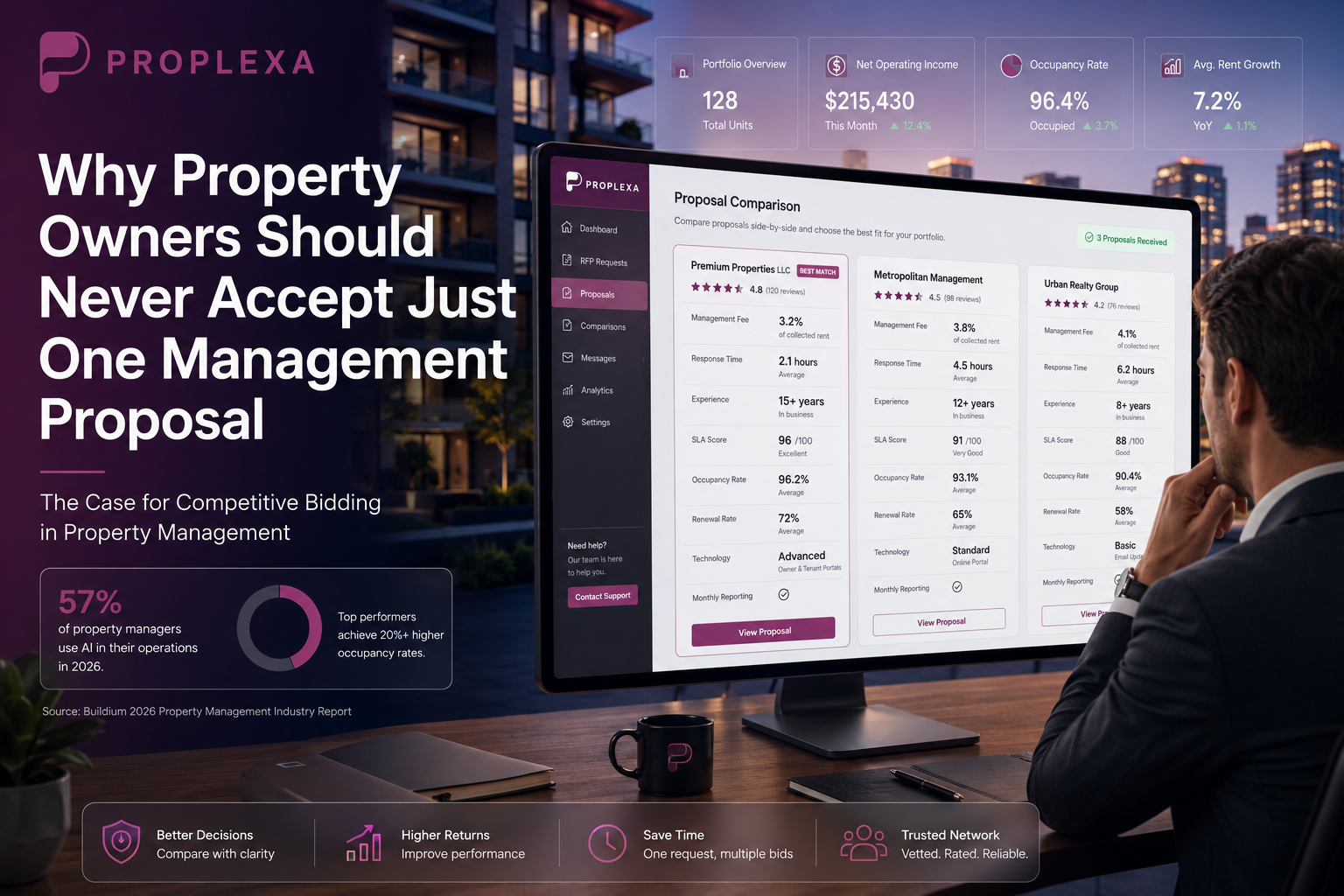
Instead of chasing proposals one at a time, property owners can publish a management request and receive multiple competitive proposals through a structured platform.
This enables side-by-side comparisons across:
- Pricing
- Experience
- Service offerings
- Response times
- Performance indicators
The result is a more transparent, efficient, and data-driven selection process.
Final Thoughts
No investor would purchase a property after evaluating only one opportunity.
No owner would select an insurance policy after receiving only one quote.
No developer would hire a contractor without comparing bids.
Property management should be no different.
The companies responsible for operating your assets have a direct impact on your financial performance.
That decision deserves more than a single proposal.
In 2026, competitive bidding is becoming the smarter way to choose a property management partner—and the owners who embrace it are likely to make better decisions, reduce risk, and improve returns over the long term.